The Killer
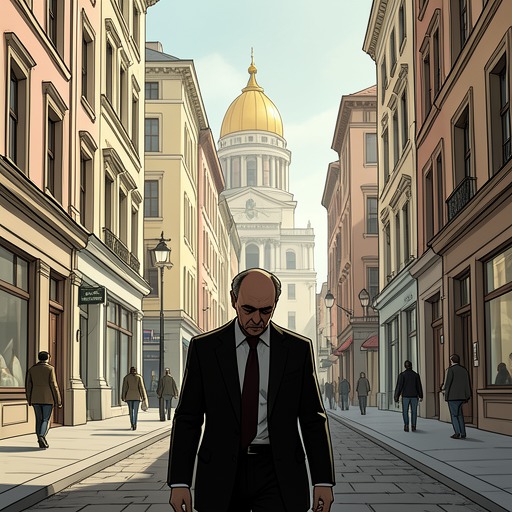
The KillerThe Killer is the nearly silent murderer whose repeated drownings turn the Radiant City’s promise of order into a spectacle of helplessness. He disguises himself as a beggar, draws passersby toward a pool with the Colonel's photograph, and kills them with a shove. When Bérenger finally confronts him, the Killer offers no explanation: he chuckles, produces a knife, and advances as Bérenger lowers his pistols and sinks to his knees.
Identity and Method
The Killer’s identity first takes shape through the pattern of his crimes rather than through a name or an account of his past. The Architect describes two or three people being found drowned in the pool every day. At the tram-stop, the Killer waits for people returning home; because private cars are not permitted outside the Radiant City, they walk toward the gates. Disguised as a beggar, he approaches them with familiar appeals about having left hospital, lacking work, and having nowhere to sleep. The story he tells is only an opening gambit: he tests the passerby, chooses a likely target, and persists in conversation.
His basket contains a scatter of small goods—artificial flowers, birds, old-style nightcaps, maps, postcards, American cigarettes, and obscene drawings. The objects serve as props in a transaction that keeps the victim beside him, even when the wares are refused. He steers the encounter toward the pool, then offers to show the Colonel's photograph. The victim leans closer in the gathering dark; while attention is fixed on the image, the Killer pushes the person into the water. The apparent exchange of alms or curiosities becomes a rehearsed mechanism for killing.
Violence in Plain Sight
The method is effective not because it is hidden, but because people continue to fall for it. Bérenger is astonished that the public knows about the trick and still gets taken in. The Architect confirms that five people have already drowned, yet dismisses the suggestion of keeping a plainclothes inspector at the pool: the inspectors are overworked, and even they might want to see the photograph. The city’s administrative response makes the Killer’s routine seem almost ordinary. His violence is recognized, discussed, and then left to recur.
A cry and the heavy sound of a body falling into water interrupt the Architect’s conversation with Bérenger. Bérenger jumps up, but the Architect remains seated, biting his sandwich, and says the Killer has struck again. His explanation is chillingly practical: a moment’s inattention is enough. The scene makes the crime audible before it makes the killer visible, while the Architect’s composure turns a fresh death into confirmation of a familiar pattern.
The Killer’s reach also exceeds what Bérenger’s immediate circle knows or is willing to treat as news. When Bérenger tells Édouard that the murderer is terrorizing the district and that it is being deserted, Édouard recognizes the beggar-and-photograph trick at once. He says he has known about it for a long time and had expected Bérenger to tell him something new. The disclosure sharpens the contrast between awareness and action: the murders are not simply unknown, yet knowledge has not ended them.
Evidence and Pursuit
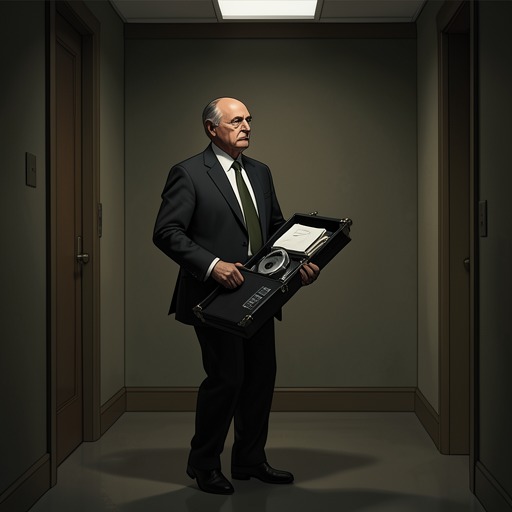
Bérenger later lays out evidence linking the Killer to the crimes: an address, an identity card, and a photograph of the man himself clipped to the Colonel's photograph. An address book supplies the names and addresses of his victims. For Bérenger, these objects convert a frightening pattern into a case that can be acted upon; he becomes excited by the prospect of catching the murderer.
Édouard then produces a neat little box containing further documents, as if revealing a conjuror’s trick. Inside is the Killer's diary. Its entries record planned or completed killings in blunt, routine terms: one announces an intention to kill, another describes pushing an old woman with gold-rimmed spectacles into a lake, and later entries complain that there was no one to kill or get his teeth into. The diary gives written form to the violence’s persistence and apparent lack of purpose. Yet its revelation does not bring the confrontation to a close; possession of evidence and the ability to stop the Killer remain separate things.
The Final Confrontation
Bérenger postpones action until tomorrow, expecting to go with Édouard and have the Superintendent arrest the Killer. His watch has stopped, and he has difficulty finding his way home. When he turns, the Killer is suddenly close. The stage directions render the encounter starkly: almost all scenery has disappeared, leaving a wall and a bench, an empty plain, and a faint glow on the horizon. The two figures stand in pale light against the surrounding half-darkness.
The Killer is described as small and puny, unshaven, dressed in a torn hat and shabby gaberdine, with toes showing through his old shoes. One eye shines with a steely glint; his expression remains fixed. He jumps down from the bench or wall and approaches, chuckling. The directions preserve an unsettling alternative: perhaps there is no Killer at all, and Bérenger is speaking to himself alone in the half-light. The uncertainty does not erase the threat; it makes the final encounter hover between a bodily attacker and the shape of Bérenger’s fear.
Bérenger demands the Killer’s philosophy, motives, and aims, but receives only chuckles. He appeals to the death of Dany, insisting that she had done nothing to deserve it, and tries to make the murderer account for the destruction of ordinary lives. He then begs him to stop killing, first for a month, then for a week or even forty-eight hours. The Killer does not answer. Instead, he slowly draws a large, shining knife from his pocket and plays with it.
Bérenger first aims his two old-fashioned pistols without firing, recognizing that his strength and bullets are no match for the Killer’s cold persistence. He then lowers the weapons, lays them on the ground, bows his head, and drops to his knees with his arms hanging at his sides. The Killer keeps approaching, still chuckling softly. The evidence that seemed to promise arrest, and the weapons that seemed to promise resistance, give way to a final image of paralysis. The Killer’s defining power is not a stated doctrine or an elaborate disguise, but the repeated ability to make murder continue while those who know of it remain unable to stop him.